

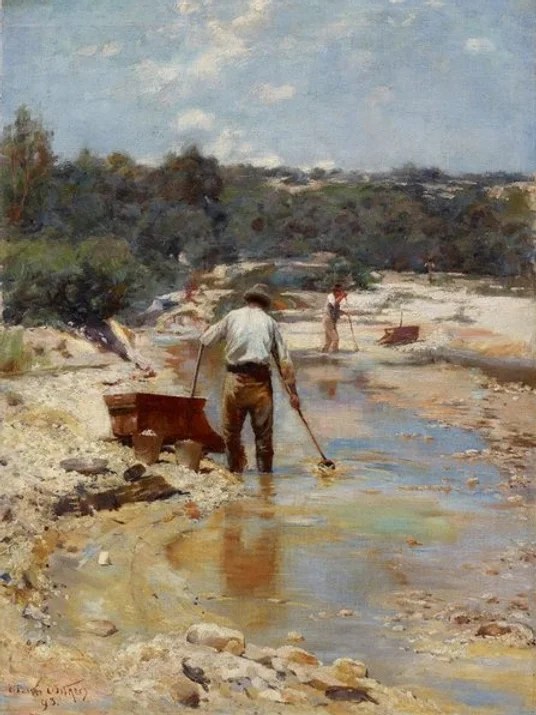
I chose to title this blog “literary detective” NOT because I’m writing about detectives in literature but because I’m in that phase of my work where I think of myself as a detective–of a sort. I’m not solving a crime but I am digging through clues. Ok, maybe detective isn’t the best metaphor. Maybe I’m…. mining for gold! Or…a scientist collecting specimens? Or maybe I’m just a literary scholar combing through databases, archives, and catalogs to find relevant texts on gold mining in the 19th century? Yes, the last one. That’s me.
I’ve been collecting stories about mining–especially gold mining–for about ten years now, and I’ve cast my net wide (so now I’m a fisherman fishing for material?). I’ve combed through OCLC, library databases, and done oh so many keyword searches to come up with my lists of my five countries under analysis: South Africa, New Zealand, Australia, the US, and Canada. There was lots of mining of different minerals going on in those spaces in the 19th century, but I’ve decided to focus on diamond and gold mining, since the majority of texts are about those subjects. Plus they are the most exciting. And I’m interested in what people were reading–what was capturing the public’s imagination.
Quick explanation: I came up with this idea when writing my last book, Frontier Fictions, which was about literary trends in the same spaces listed above–excepting New Zealand. I noticed that a significant story that didn’t really fit what I was doing there (looking at how the settler/indigene relationship was represented and what that meant for settlers being able to not feel guilt or shame about their obvious stealing of land and murder of the people who already lived there). The story that didn’t fit was about mining. There were a number of mining texts, but they involved more players than the typical settler narrative–which I, in that book, called the “contact settler” story, but which really was about first generation settlers–who came to a place and had to carve out their own space–not join communities and towns–at least not in the story, despite what was actually going on there. The mining story, though, told something different–even though being written and published side by side with the contact settler stories. The mining story was about intending to go to a place NOT to stay but to make one’s fortune to return home (which isn’t what really happened, but that’s what the story is about). The mining story also is about a range of “races”–not just settler/indigene but also a range of settlers from different European spaces, indigenous people, and most significantly, the Chinese. So, my question was: what work are these stories doing? If the contact settler story helped generations of settlers not feel guilty about having stolen the land from indigenous people, what were these mining stories doing? The contact settler stories had significant trends or themes that I collected and discussed in terms of different defense mechanisms: stories about the settler’s relationship with animals (both hunting and making pets), stories about the settler relationship with the landscape (taming it and farming it), stories about the settler and indigene (both hostile and friendly as well as romantic), stories about the settler and children (his own and those of others)–all these stories, I argued there, functioned as defense mechanisms. So…. what’s going on with these mining stories? The same?
With my prior two books (the first was on island stories), my methodology is to gather as many texts as possible along a certain line and then to read them all, letting my big brain sift through all of them to find where the areas of commonality are–what is significant across the corpus. My goal is to understand how literature affected the way people thought during the height of empire and colonization–and I’ve found psychoanalytic theory to be super helpful in understanding how the stories might affect individual and collective thoughts and feelings. So, I want to look for large themes to get a sense of a reading culture, not just an individual genius. And so I’m also interested in what was popular–not just in what was good–and I mean popular in terms of being written by many writers (even of not well-read by others) as well as what was popular in a reading public.
With all that said and explained, here’s where I am now. I’ve collected this many texts from across my five spaces and am still combing databases for more. You can see that I have the fewest from South Africa and New Zealand and the most from the US, Canada, and Australia. I wonder why.
I should say that I don’t just read fictional material. I’m also interested in diaries, of course, since those present a sort of personal narrative of an experience, which is always filtered through the consciousness and one’s need to be a hero of one’s story. I also am interested in texts about mining from a governmental view–what were the governments telling miners and would-be miners? And how honest were they being? And also texts from a more scientific view. What did they actually know about mining at the time that was being shared with the larger public?
100 Australian texts (at the moment).
46 New Zealand texts.
52 South African texts
81 American texts
43 Canadian texts
And that’s not counting the criticism. These are my texts and counting. I’m discovering more every day. Exciting work! Back to the…. what was the metaphor I landed on? Mining for gold?


Leave a Reply