


I’m creating this blog with two goals in mind: I know that as a modern academic, I need to be publicizing my work. That’s just how the publishing world works now. And a blog and frequent social media posts are my initial stab at marketing a book that is in progress–and by that I mean my book about settler mining stories.
But I also want a place to record all of the cool books I’m reading (and hopefully the cool ideas I’m having), because I know that the final book will include about 1/4 of what it could. I’ll write what I want. And then I’ll cut that down by moving some material to footnotes. And then I’ll have to cut the footnotes. And some actually interesting material will never see the light of day–and maybe that’s ok in the long run. But in the short term I’m going to use this blog to help me feel better about how little I’m going to include in the book.
I will at some point also include a total list of the materials (primary and secondary and the art I’ve found), again as a way to share some of this with the world. So many of these books I’ve tracked down and scanned. And since they are out of copyright, there’s no reason I can’t share this work with you, reader.
And art–there is so much art out there! Each day I’ll include an image, even if I don’t have much to say about it, just to share it with the world. Many of these come from the excellent National Library Australia collection of art (available digitally on their website) but other images are personal photographs of museum exhibits or art from books.
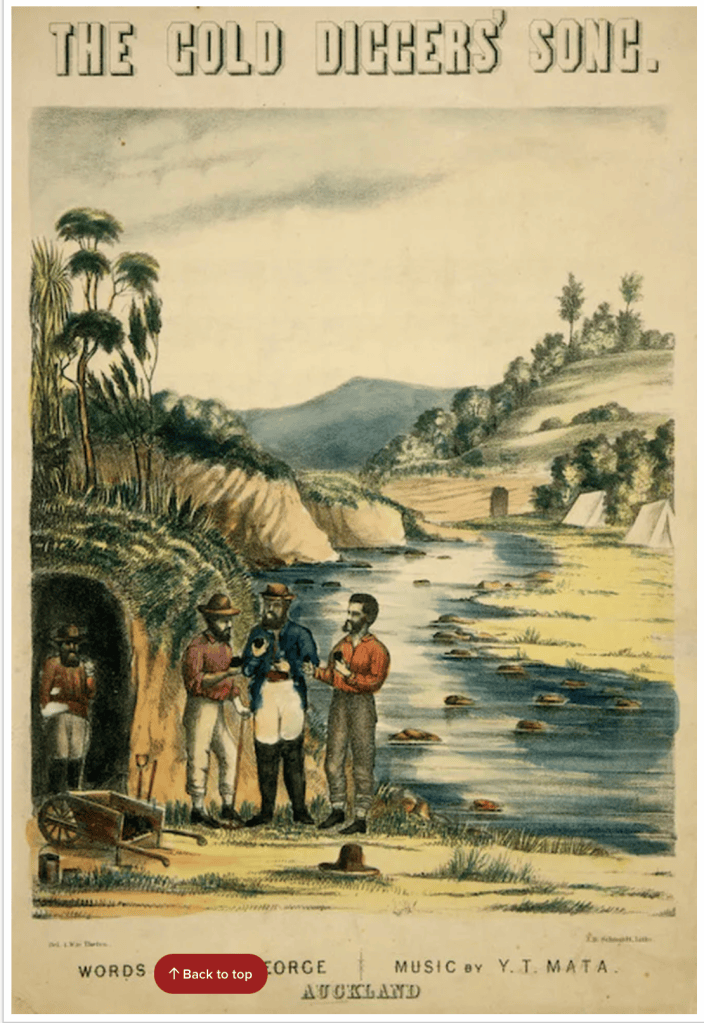
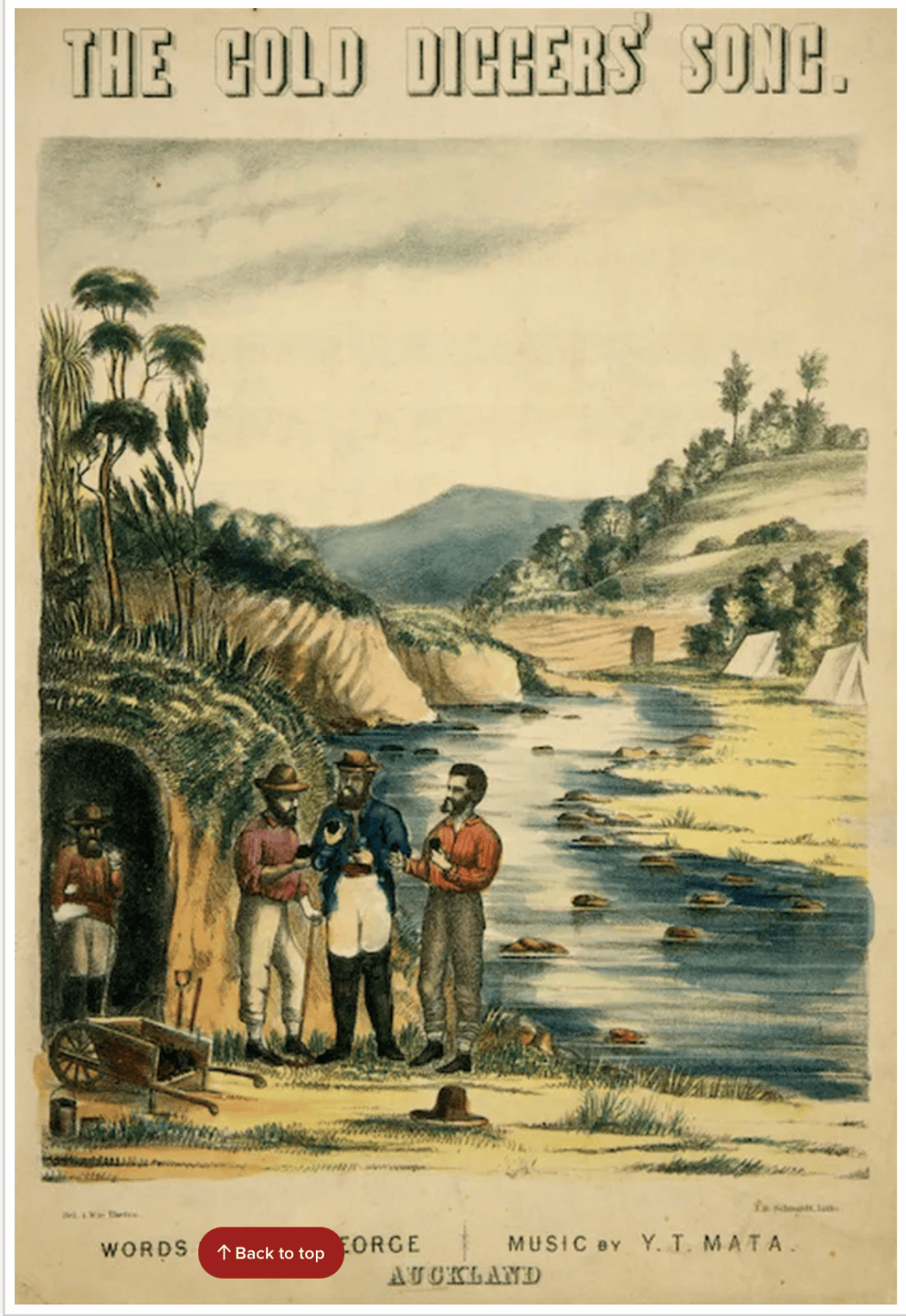
Take this image, for instance, which is a gorgeous cover from a piece of music, “The Gold Diggers’ Song.” Music in the late 19th-early 20th centuries was, of course, song music sold for live performances. Recordings didn’t much exist then (note to self–look up more on the history of early music recordings). And I imagine that part of the appeal of a song was not only the music itself but also the image that was on the cover. And look at this image–it’s telling a story of New Zealand gold mining.
You can see the four miners, three talking and comparing rocks, which one wonders might contain gold. The rocks look like coal, but the song title identifies this as gold. They’re in conversation, while the fourth man is inside a cavern, likely man made and part of mining. This image, then, might show a transition between surface/placer mining or underground mining. It might be that this image shows a shift between individual claims and mining efforts and communal, as miners started to work together when the digging got more difficult and the machinery more expensive than one man could handle. But in the foreground are tools that are mainly for placer mining– a wheelbarrow, and shovels. And the men are by a stream, which is where early placer mining took place, as miners looked for gold that had been washed down from veins in the hills.
The landscape here is beautiful, showing what looks to be an ideal New Zealand day, with the tents of a mining camp in the background. But there also looks like there might be a gravestone next to those tents, reminding that mining was a perilous job and that the death rate was high. The risks were great, but the rewards could be great, as well.
Finally–one thing that puzzles me about this image: one man’s hat is on the ground while the other three have theirs on their heads. Why? Why would the artist make this distinction?
I have collected hundreds of mining images and other texts, and I’m happy to share them with you. Please leave comments about this post or the overall project. I’d love to meet you!
 Rebecca Weaver-Hightower
Leave a comment