


Halloween inspires me to post about ghosts and ghost towns in mining stories. (I have a whole chapter about ghosts coming up later, so this is a preview!)
A plot point in some of the texts I’ve been reading is the fake haunting used to protect treasure—and yes, that is a well-known Scooby-Doo plot! It’s a trope that is everywhere in popular culture, from reality TV and video games to haunted mining attractions at theme parks.
As Jeff O’Connor notes in his 2025 post “Mine Ghosts: Apparitions in the Abyss,” “Mining communities all around the world have made up rich folklore about these underground hauntings over the years.”
Why goldfields felt haunted
But just to set the stage—gold fields in the 19th and early 20th centuries must have been places ripe for miners to imagine ghosts and hauntings. Mining was deadly work, so goldfields filled their graveyards quickly. The nights were dark and sometimes lonely, and if a miner had found any gold at all, paranoia at being murdered and robbed (real threats) would have been rampant. And this is just talking about placer mining, which is above ground. For miners going underground and working in the pitch black, ghosts must have been even more of a fear. Death was just around the corner, from cave-ins to suffocation from fumes, which would have brought a constant fear of the restless dead. Finally, mining towns, “boom towns,” could quickly “go bust” once the gold ran out, leaving a “ghost town” full of memories, regrets, and lingering dreams.
A ghost in a bullock skull
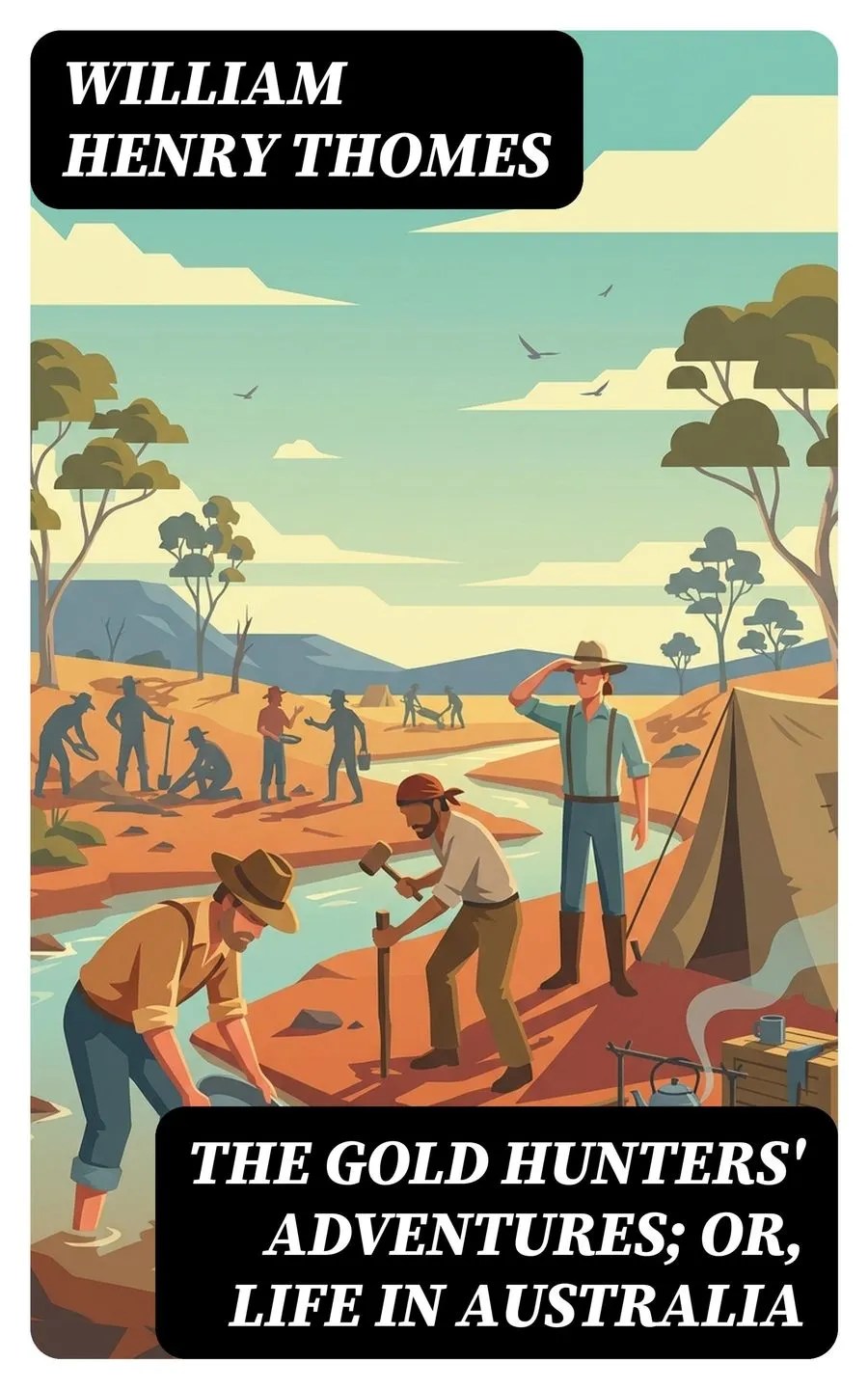
One of the texts that made me think of this topic is William H. Thomes, The Gold Hunters’ Adventures; or, Life in Australia (1864). Thomes was an American adventurer, author, and Boston publisher who did, for a time, work as a miner in California and store owner in Australia, experiences that clearly inspired his first novel, The Gold Hunters’ Adventures. In a nutshell, the novel follows two Yankee miners who leave California for the Victorian goldfields of the 1850s, where they fight bushrangers, open a store at Ballarat, hunt buried treasure guarded by a fake ghost, and witness a thinly fictionalized Eureka Stockade before sailing home rich. The novel is juicy with themes I examine in my book, but for today, let’s focus on the ghost story, where a former body-snatcher dresses as the ghost of a murdered squatter (an Australian rancher or farmer) to guard a bushranger’s buried loot.
One of the characters is a policeman, Brown, to whom a dying bushranger (an Australian robber) reveals where he buried his loot on a nearby island. Brown enlists his friend, Jack, to search for the gold. They find the spot where it’s meant to be hidden (as revealed by a cross-shaped shadow cast by moonlight) and begin digging. The site is spooky, but they talk about a local legend of a murdered man said to haunt where they are digging: “we were not in a favorable place to talk about ghosts and goblins, for the trees under which we were lying screened the light of the stars, and prevented us from seeing each other.”
They continue digging but are interrupted by a groan: “I was about to [use the shovel], but a groan, louder and more unearthly than the original ones, prevented me. ‘What, in the devil’s name, is that?’ demanded [Brown],” to which Jack answers, “perhaps one of your ghosts that you have talked so much about”.
The miners talk more about ghosts and get increasingly scared, “when from the earth arose a form that seemed at least ten feet high. It was clothed in white, and from its head projected two monstrous horns, which were pointed towards us in a threatening manner. I could discern no features, but a huge mass of white bones were visible where the face should have been, and I thought that I could hear them rattle as the beast, devil, or ghost shook its head in an ominous manner, and advanced towards us”.
From the earth arose a form that seemed at least ten feet high. It was clothed in white, and from its head projected two monstrous horns.
William H. Thomes, The Gold Hunters’ Adventures (1864)
Understandably, they take off running, “with the speed of a greyhound, towards the bridge that connected the island with the main land.” One of the miners accidentally steps into quicksand and begins sinking. As the other searches for a way to save him, he describes how “I heard, with awful distinctness, the sound of the pickaxe, as it was struck against the rocks upon the island, worked, I had no doubt, by supernatural hands.” The situation looks dire, but Brown is saved when Jack thinks to strip off his pants and use them as a rope to pull him from the quicksand. Which works!
After more discussion, and some “Dutch courage” in the form of a swig each from their flask, they decide to return to face the ghost. They find him digging with a pickaxe, and Jack fires at him with his revolver. After “a crashing of dry bones,” Jack sees “the hideous head fall to the ground” and “a gruff voice” shouts, “What in the bloody h–l is you ’bout, hey?”
Hearing the ghost speak and recognizing him as a man, Jack and Brown sit down with him to hear his story. It turns out that the ghost is a man named Day, a local shepherd who once worked as a body-snatcher. Day has been impersonating the squatter’s ghost to scare people away from the stolen gold. A bushranger gang then arrives looking for the same treasure. Day puts his ghost act to work against them: wearing a flaming bullock-skull headdress, he scatters the gang and digs up the treasure, which they share. And so, a gang of thieves and a former grave-robber fight over stolen gold, and the weapon is the ghost of a murdered pioneer.
What is the ghost guarding?
The idea of the ghost was the weapon in this story (and others I won’t get into yet). But the larger question is: what is the ghost story protecting? The gold, of course, but what else? The ghost does what a claim marker does: it keeps other people off the ground. And it borrows the authority of a murdered pioneer to guard what thieves stole. The mining ghost story, I argue in the book I’m writing, is a reminder of the earlier (Indigenous) owner who probably never appears in the story. As Ken Gelder and Jane M. Jacobs argue in Uncanny Australia (1998) in relation to Indigenous Australian claims of sacredness, the settler colonial world has an uncanniness about it, in that what settlers try to ignore, repress, or erase about original owners is still evident on some register, creating a strange echo and making the settled feel haunted.
Ghost towns and tourists
It’s a bit ironic, then, that the use of modern-day ghosts is not to keep people away from mining towns but to bring them in. (For a taste of this, see Lauren Markham’s California road trip for Alta Journal, “The Ghosts of Ghost Towns.”) But…how do the REAL ghosts (because ghosts are real, y’all) feel about all of this ghost town tourism? They don’t seem to be doing their job at keeping out the lookie-loos (yours truly included). Could it be that they like the attention?
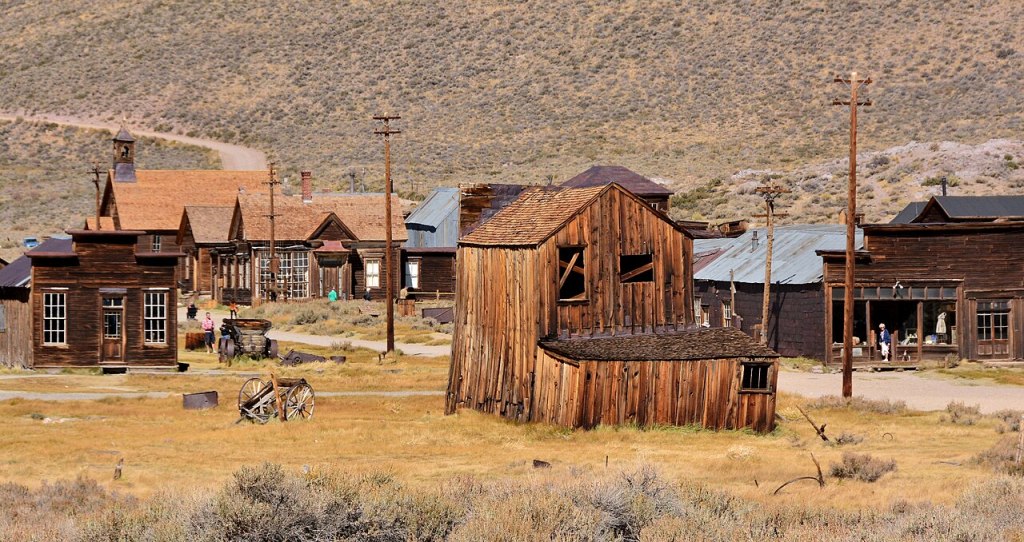
I’m not the only one interested in this issue of ghost stories and mining. In researching this post, I ran across another blog post, “The changing faces of ghosts in the Wild West … or what I learned from #FolkloreThursday” by folklorist and historian Ronald M. James. James relates several other historical ghost stories and discusses the Folklore Thursday project, sharing some of his own work on “Wild West” folklore and on how “above ground” mining lore differed from “below ground.” I would love to hear comments from readers about any of this.
Is there a ghost in this picture?
Finally, I’d like to include a piece of art I’ve always thought was interesting because of how it suggests a ghost miner, though I don’t think that’s what the artist intended.
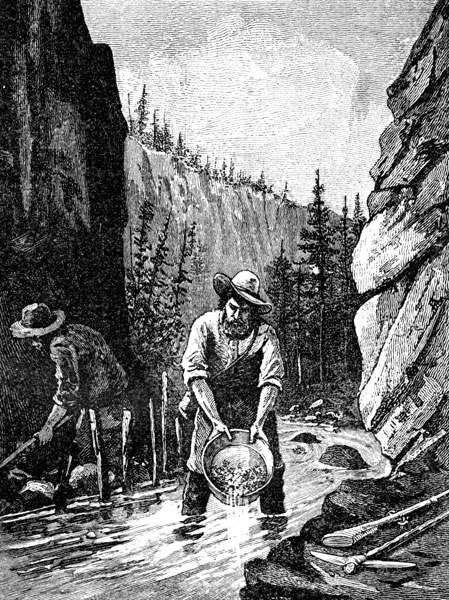
The image is put together so that one miner is center and panning for gold, and another, less substantial miner is shown to his right (on the left side of the image) doing…it’s not clear. Is he panning also? That would make sense standing in the creek. But he doesn’t really seem to be standing in the creek but more…standing in the rocks on the creek’s edge? But that doesn’t look right either, because his legs disappear where the rocks are. His proportions are all wrong for standing there. He seems to be standing in the same place as the rocks—as might a ghost. He holds something in his hands—a pickaxe, perhaps. But why would he hold that in the creek? And then there are sticks poking up out of the creek that seem to go through his body, again, as if he’s not really there.
So…here’s my theory. This drawing shows a miner and a ghost of a miner: a man laboring against nature to strike it rich, and the man who lost the fight with nature but is now doomed to repeat those actions until…maybe until someone finds gold there and releases him from his toil. Let’s imagine a happy ending!
What do you think is going on here? Comment below and subscribe! And if you’d like to read more of my work on settler colonialism, visit my Publications page.


Leave a Reply